

Am I Mad At Yoga?
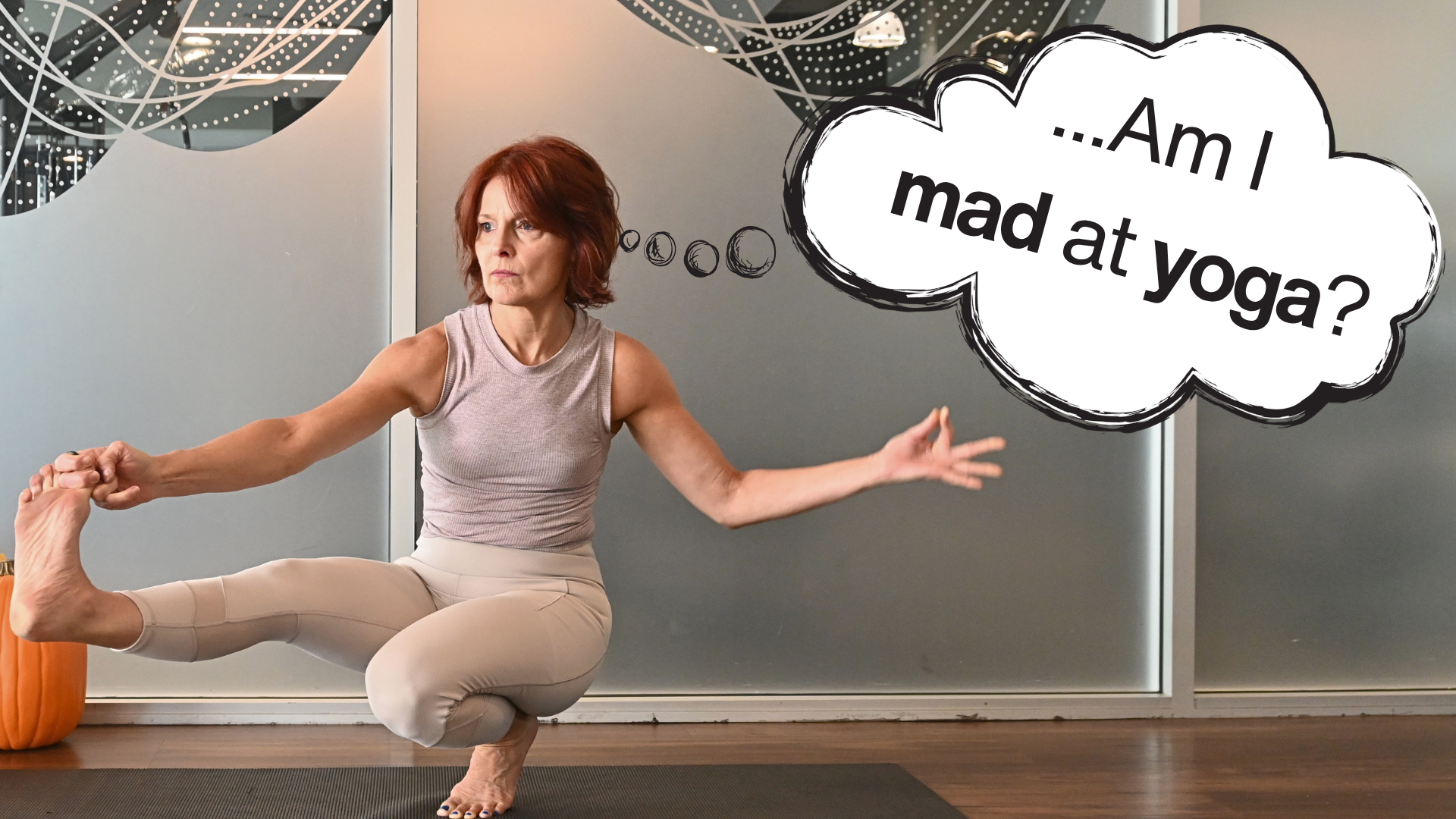
I have been practicing yoga for 33 years. Sometimes when I practice yoga today, I hurt.
I have been in yoga—teaching or practicing—sometimes ten times a week over that time.
That is a lot of downward-facing dogs. And jump-backs. And crows. And bare feet on hard floors. And hours upon hours of stretching.
So, am I mad at yoga?
If I put the pieces together, some of what I experience today looks a lot like what we would call overuse in any other sport.
I overused my toe joints. Think decades of bare feet on hard studio floors, toes tucked under, jump-backs and pushing through the feet.
I overused my thumb joints. Think thousands of downward-facing dogs and arm balances—and a period of my life when my thumbs seemed to be the only thing standing between me and falling on my head.
And then there is connective tissue.
I LOVE to stretch. I also love crow.
I don't do nearly as much of either anymore.
But here's the thing: I'm not mad at yoga.
Some of those hours were absolutely spent in a high-performance mindset. Some poses were probably unnecessary. Some were completely egotistical.
Look what I can do.
But most of the time, that wasn't why I came to yoga. I came to regulate myself and to meditate, but I also genuinely loved the postures—the concentration they required and the experience of becoming completely absorbed in what my body, breath and mind were doing at the same time.
Now, more than three decades later, I can see something I couldn't possibly have understood when I started:
Yoga prepared me for almost everything that came next.
The Yogi Is an Endurance Athlete.
We don't talk about this enough.
A person who develops a yoga practice and keeps returning year after year is practicing a form of endurance.
Not marathon endurance. Practice endurance.
You return, breathe and pay attention. You stabilize and strengthen. You get distracted and come back. Your body changes, you age, the practice changes—and you come back again.
I see it at Thrive every day. Our members check into class week after week, year after year. We may think they are simply taking yoga classes, but they are repeatedly practicing conscious breathing, concentration, stability, strength, mobility, balance, patience and the ability to become quiet enough to notice what is happening inside themselves.
Then tomorrow, they practice again.
To me, the yogi is an endurance athlete.
Research supports what longtime practitioners often feel. Meta-analyses in older adults have found yoga improves balance, flexibility and muscle strength, with additional benefits reported for sleep, vitality and mental health.
And then there is the spine.
A 2024 systematic review found evidence that yoga can improve spinal flexibility and mobility, particularly in people with chronic low-back pain.
That matters to me personally.
I don't believe I would have achieved the level of fitness I have today without the physical vocabulary yoga gave me first. Decades of practice gave me spinal mobility, body awareness and an unusually developed sense of where my body is in space. It taught me how to organize movement, make small positional adjustments, coordinate movement with breath and stay focused when something becomes physically difficult.
Those skills don't replace strength training. They make me better able to strength train.
At this point in my life, I want muscle, strength, cardiovascular fitness and power. Yoga doesn't have to provide all of those things. It gave me the foundation from which to pursue them.
Yoga Was Training Me for Healthspan
This is where I think yoga becomes much bigger than yoga.
Start running? You already understand something about breathing, pacing and staying present when your body becomes uncomfortable. Start strength training? You arrive with experience in alignment, joint position, concentration and stability.
The activity changes. The skills transfer.
So do they when life gets hard.
Loss. Fear. Stress. A major transition you didn't plan for. Years of yoga have given you practice noticing your internal state, slowing your breathing and staying present without immediately reacting. Research supports this too: meta-analyses have found reductions in perceived stress associated with yoga.
And that brings me to healthspan.
Healthspan isn't just VO₂ max, muscle mass, mobility, balance, sleep, nutrition or stress management. It is having enough physical and cognitive capacity to keep participating in your own life.
Suddenly the decades of yoga look very different to me.
Balance keeps us upright. Strength keeps us capable. Mobility lets us use that strength. Body awareness tells us where we are in space. The ability to regulate stress matters because health isn't only what our muscles can do.
And then there is consistency.
Perhaps yoga's greatest contribution to my healthspan isn't a pose at all.
Yoga taught me how to practice.
When I began strength training seriously, I already understood practice. When I began paying closer attention to cardiovascular fitness, recovery, sleep and healthspan, I understood practice.
Yoga had been teaching me the skill underneath all of them for 33 years:
Show up. Pay attention. Adjust. Keep going.
Maybe that's why I look at consistent yoga students and think: You have no idea how prepared you are for what comes next.
Which Brings Me Back to Being Mad
Interestingly, I have found it harder to get all that mad lately.
I have to give some credit here to another practice I have adopted: cold plunging.
I'm careful about making big claims about cold plunging—the research does not show that it eliminates emotional triggers. But repeated cold exposure does produce something fascinating: habituation. With repeated immersion, research shows that the body's initial cold-shock response becomes less dramatic. A small fMRI study has also found changes in brain networks involved in attention, emotion and self-regulation after cold-water immersion.
What interests me is how closely that resembles my experience.
I voluntarily enter cold water and every cell in my body screams:
GET OUT.
And I don't.
I breathe. I stay. I watch the alarm rise and learn that I don't have to obey it.
Sound familiar?
That's yoga.
Different classroom. Same lesson.
I can't tell you that cold plunging has eliminated my triggers. But I can tell you what I notice: I am less reactive. There is a little more space between the alarm and my response—and in that space, I have a choice.
Maybe cold water is simply giving me another place to practice something yoga has been teaching me all along: feel the reaction, breathe, choose what happens next.
So, Am I Mad at Yoga?
No.
My practice is different now. There are poses I don't need anymore, range of motion I don't need to chase and joints that have earned the right to tell me, Enough.
At this point in my life, listening to that message may be a far more advanced yoga practice than another crow pose.
Because all those crows mattered too. The thousands of downward-facing dogs mattered. Even some of the completely egotistical poses mattered.
They led me here.
Yoga gave me a relationship with my body that has lasted more than three decades. It taught me how to pay attention, breathe, focus, recover, endure and—eventually—how to change.
Maybe that's the point.
The practice isn't supposed to remain the same because we don't remain the same.
At 30, yoga may ask you to discover what your body can do. Later, it may ask whether you are wise enough to stop doing some of it.
Both are practice.
So no, I'm not mad at yoga.
I am profoundly grateful for it.
Because after all these years, I understand something I couldn't have understood when I began:
Yoga was never really about how far I could go into a pose. It was teaching me how to stay—how to adapt, how to breathe, how to begin again, and how to keep practicing as the person doing the practicing changes.
And I suspect it will be the practice that stays with me all the way to my last breath.
FREE MOMENTUM SNEAK PEEK
Wednesday September 9th
6pm - 7:30pm
Research & References
Yoga, physical function and aging
Ko J-E, et al. Effects of yoga on physical and psychological health among community-dwelling older adults: A systematic review and meta-analysis. International Journal of Older People Nursing, 2023. The meta-analysis found significant improvements in balance, flexibility and muscle strength.
Sivaramakrishnan D, et al. The effects of yoga compared to active and inactive controls on physical function and health-related quality of life in older adults: systematic review and meta-analysis of randomized controlled trials. International Journal of Behavioral Nutrition and Physical Activity, 2019. Twenty-two RCTs; improvements included balance, lower-limb strength, lower-body flexibility, depression, sleep quality and vitality.
Youkhana S, et al. Yoga-based exercise improves balance and mobility in people aged 60 and over: a systematic review and meta-analysis. Age and Ageing, 2016.
Bajaj P, et al. Effect of yoga on balance, falls, and bone metabolism: a systematic review of randomized controlled trials in healthy individuals. Osteoporosis International, 2025. Eighteen RCTs involving 1,408 participants; evidence favored yoga for balance, while evidence for bone mineral density remained inconclusive.
Spine and musculoskeletal function
Rathore V, Singh S, Katiyar VK. Exploring the therapeutic effects of yoga on spine and shoulder mobility: A systematic review. Journal of Bodywork and Movement Therapies, 2024.
Wieland LS, et al. Yoga for chronic non-specific low back pain. Cochrane Database of Systematic Reviews, 2022. This review found small improvements compared with no exercise and little or no difference from other back-focused exercise.
Stress and mental well-being
Rhoads MC, et al. Yoga as an intervention for stress: a meta-analysis. Health Psychology Review, 2025. Thirty-six studies; yoga produced a statistically significant moderate reduction in perceived stress.
Schleinzer A, et al. Effects of yoga on stress in stressed adults: a systematic review and meta-analysis. Frontiers in Psychiatry, 2024. Thirteen RCTs involving 1,026 participants.
Cold-water immersion and habituation
Barwood MJ, et al. Habituation of the cold shock response: A systematic review and meta-analysis. Journal of Thermal Biology, 2024. Repeated cold-water immersion produced measurable habituation in heart-rate and respiratory components of the cold-shock response.
Yankouskaya A, et al. Short-Term Head-Out Whole-Body Cold-Water Immersion Facilitates Positive Affect and Increases Interaction between Large-Scale Brain Networks. Biology, 2023. fMRI study examining mood and brain-network connectivity before and after cold-water immersion.
